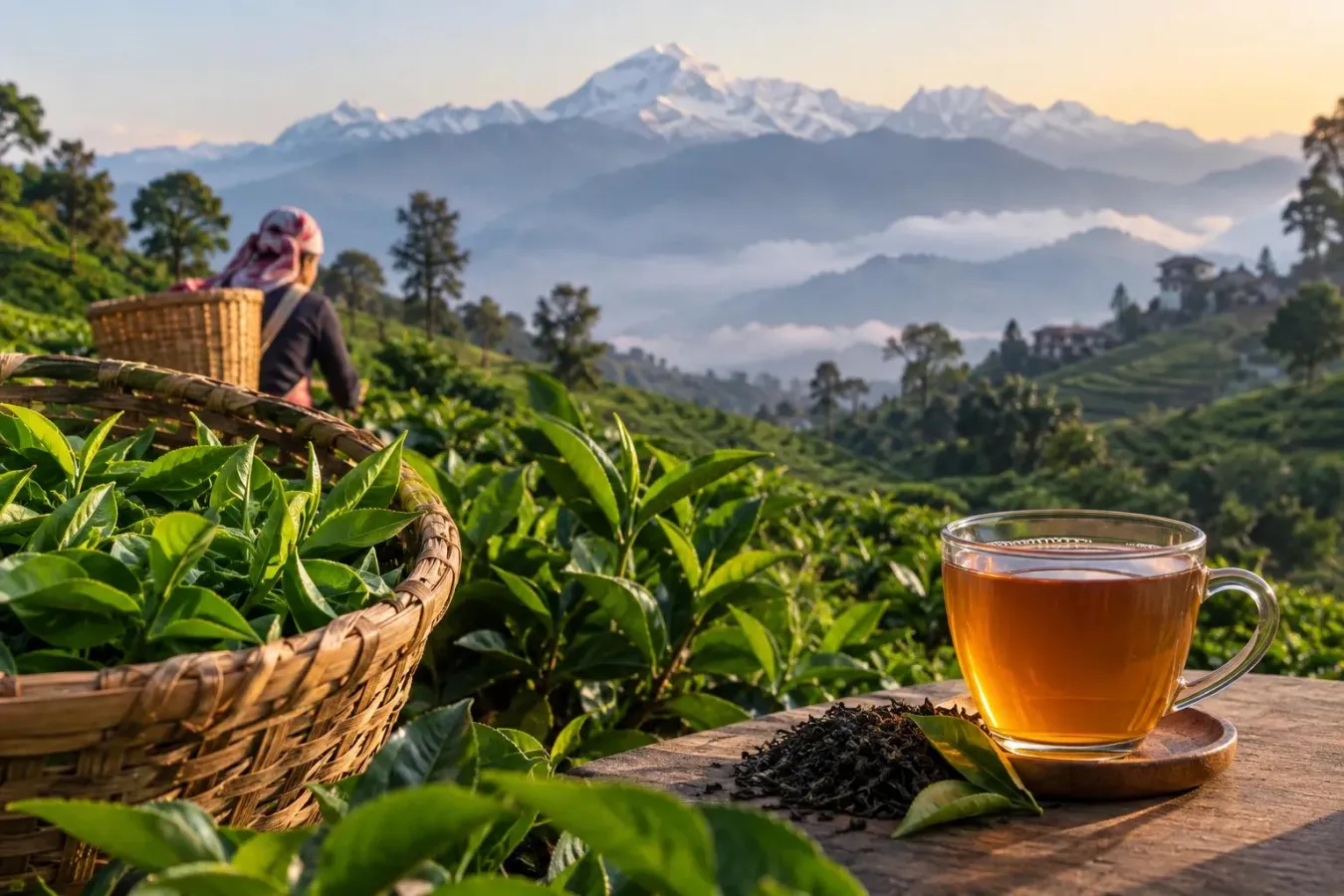
Nepal's eastern hills — from Ilam and Panchthar to Dhankuta, Terhathum and the plains of Jhapa — grow tea that connoisseurs abroad rate alongside Darjeeling. Yet the story of chiya in the export market is a familiar Nepali paradox: a genuinely world-class product, sold cheap, mostly to one neighbour, and rarely under its own name. As Nepal debates graduation from Least Developed Country status and looks for exports that can survive without preferential trade treatment, tea is a useful case study — of potential, of policy drift, and of what a handful of determined producers are already doing about it.
1. Current Affairs: A Trade Too Dependent on One Border
Nepal now produces roughly 33 million kg of tea a year — about 27 million kg of CTC (Crush, Tear, Curl), the bulk tea used in milk tea, and 6.5–7 million kg of orthodox tea, the hand-processed, high-value leaf grown mostly in the hills. Commercial cultivation, once confined to Jhapa and Ilam, has now spread to Sankhuwasabha, Taplejung, Dhankuta, Panchthar and even parts of Bagmati, Gandaki, Lumbini and Sudurpaschim — and the sector sustains an estimated 60,000-plus livelihoods.
But the export numbers tell a story of concentration, not diversification. In the first eleven months of fiscal year 2025/26, Nepal exported about 11.74 million kg of tea — and 11 million kg of it went to India alone. The roughly three dozen other buying countries, including Russia, the US, Japan, Germany and the UAE, together took just 740 kg. For orthodox tea specifically, over 88 percent still crosses into India, where much of it is blended, repackaged and sold onward under other labels often Darjeeling's.
The last year has also shown how fragile that dependence is. Nepal's tea exports fell by more than 2,260 tones in FY 2025/26 compared with the year before, costing the sector close to Rs 640 million in lost revenue, as Indian buyers cut back amid price swings and stiffer quality checks. That fragility turned into a full-blown shock in mid-2025, when India's Tea Board began mandating quality testing on every single consignment. Reports could take weeks, sometimes months to clear. Over fifty Nepali orthodox and CTC factories shut down within a single week, more than a million kilograms of tea sat unsold, and roughly 300,000 kg was stranded in Kolkata warehouses. For a sector where nine in every ten kilograms exits through one border, a single regulatory change on the other side was enough to idle an entire industry.
Meanwhile, at home, the government quietly withdrew the cash-incentive scheme that exporters relied on to offset these very risks just as producers say they needed it most.
2. A Real Example: What One Estate Is Doing Differently
Not every tea grower is waiting for the market to fix itself. Kanchanjangha Tea Estate and Research Centre (KTERC), in Phidim, eastern Nepal, became the country's first certified-organic tea garden back in 1984, and remains the only Fair Trade-certified garden in Nepal, now holding organic certification from IMO, NASAA, JAS and USDA-NOP. Roughly a hundred smallholder families pooled their land to build the estate as a farmer-owned cooperative; today it supports around 600 farmers, offers subsidized housing, free education for workers' children, and a "cow bank" scheme that shares livestock and income among cooperative members.
The estate's export arm, Nepal Tea Collective, run by second- and third-generation family members now based partly in the United States, was built specifically to break the pattern described above: growers producing premium organic tea that then disappears into someone else's supply chain and someone else's label. The company sells single-origin, traceable tea directly to conscious consumers abroad, lets buyers scan a QR code to tip the farmer who grew their tea, and has introduced compostable, plant-based tea bags pledging to plant a tea sapling, absorbing an estimated five pounds of CO2, for every package sold.
That last point speaks of a wider problem the industry has been slow to confront with waste. Tea processing generates fibrous waste, dust and stalks, and packaging foil pouches, plastic-lined bags, non-biodegradable sachets that mostly heads to landfill or are burned in the absence of formal recycling infrastructure in the hills. Estates like KTERC, by moving to compostable bags and channeling processing residue back into farm composting, show that waste management can be built into the product rather than bolted on afterward. But this remains the exception. Most of Nepal's roughly 140 tea estates and thousands of smallholder-supplied factories have neither the capital nor the buyer pressure to invest in it — because most of what they produce is sold in bulk to Indian traders who are not asking for compostable packaging or a carbon story. Responsibility for closing that gap sits with several actors at once: individual estates that under-invest in cleaner processing, the collection agents and CTC factories that priorities volume over traceability, and a government that has yet to attach environmental or labor standards to the incentives it offers exporters.
3. Existing Government Policy: Support That Doesn't Quite Reach the Ground
On paper, Nepal has apparatus in place. The National Tea and Coffee Development Board (NTCDB), under the Ministry of Agriculture and Livestock Development, is the state's designated agency for the sector, and orthodox tea has since been marketed under a national trademark "Nepal Tea: Quality from the Himalayas" intended to help exporters stop losing their identity to relabeling abroad. Nepal's WTO membership also gives its tea duty-free access to several markets, and organic, Fair Trade-certified orthodox tea from gardens like KTERC has real export headroom in markets such as Japan, Germany and the Netherlands.
The government's main financial tool has been a cash-subsidy scheme: exporters of processed tea could claim a 5 percent cash-back on export value (more if value addition exceeded 50 percent, or if the product carried a collective trademark such as "Nepal Tea"), funded through an annual allocation running into hundreds of millions of rupees. In September 2025, however, the Ministry of Industry, Commerce and Supplies stopped accepting the self-declaration forms exporters needed to claim it, effectively suspending the scheme pending a policy review — even as Nepal prepares for LDC graduation, a transition that will strip away several other trade preferences at the same time. Industry bodies, including the Federation of Nepalese Chambers of Commerce and Industry and the Society of Tea Producers Association, have since been lobbying for its reinstatement, warning that withdrawing support now, just as India tightens its own import scrutiny, leaves growers exposed on two fronts simultaneously. Separately, the NTCDB does offer planting subsidies covering up to half the establishment cost for new tea (and coffee) cultivation — useful for expanding the resource base, but it does little to solve the export-market and branding problem that keeps Nepali tea underpriced.
4. What Would Actually Help
The tools to fix this are not exotic Nepal Tea Collective's own model, and similar work by estates such as La Mandala and Barahá, already point the way. What's missing is scale and state backing.
Diversify away from the Indian border. With less than 2 percent of Nepali tea currently reaching third countries, market-diversification support trade missions, tasting events, and help meeting sanitary and phytosanitary standards in the US, EU, Japan and Gulf markets — would reduce the industry's exposure to any single trading partner's regulatory mood.
Restore and redesign the export incentive, trying it explicitly to value addition, organic certification and traceability, rather than reinstating a flat cashback with no environmental or branding conditions attached.
Subsidies certification, not just cultivation. Organic and Fair-Trade certification is expensive for smallholders; a state-backed certification fund would let more cooperatives follow KTERC's route to premium markets instead of selling raw leaf across the border at bulk prices.
Build shared processing and testing infrastructure in the hills, so smaller estates can meet the kind of consignment-level quality checks that shut down factories overnight in 2025 instead of each one having to solve this alone.
Make sustainable packaging and waste handling a condition of the "Nepal Tea" trademark, not an optional extra, so that branding, quality and environmental practice reinforce each other in the eyes of foreign buyers.
Done well, this is not a marginal gain. Nepal already earns far more from tea than it spends importing it, and every kilogram sold as branded, traceable "Nepal Tea" rather than unlabeled bulk leaf captures value that currently accrues to traders elsewhere. For an economy short of foreign-exchange earners, and for tens of thousands of hill farmers whose income depends on this one crop, the difference between exporting a commodity and exporting a brand is, quite literally, the difference between surviving on someone else's terms and setting your own.
Going from a bulk-commodity crop to a globally recognized brand is really a sequence of deliberate choices Nepal Tea Collective has already made several of them, and they're a useful template. Here's how it works, layer by layer.
1. Own the story, not just the leaf. The biggest reason Nepali tea underperforms internationally is that it arrives at foreign shelves with someone else's name on it sold to India in bulk, blended, and resold as Darjeeling. Going international starts with refusing that arrangement: single-origin labeling, a named estate, a named family or cooperative, GPS-traceable sourcing. Buyers abroad, especially in specialty and wellness markets, pay a premium for provenance they can verify, not for generic "Himalayan tea."
2. Certify for the market you're targeting. Organic (USDA NOP, EU Organic), Fair Trade, and JAS (for Japan) aren't just ethics badges they're the entry ticket to premium retail and specialty cafés in the US, EU, and Japan, where uncertified bulk tea simply can't compete on price with Kenyan or Sri Lankan CTC. Certification is expensive for a smallholder alone, which is why cooperative-level certification (like KTERC's) spreads that cost across many farmers.
3. Sell direct-to-consumer, not just through trade intermediaries. The traditional export model sells to an Indian or European trading house, they blend and rebrand captures almost all the margin for the middleman. A DTC or small-specialty-retailer model (online storefront, wholesale to independent tea shops, subscription boxes) keeps the brand name attached to the product all the way to the cup and captures far more of the final retail price for the farmer.
4. Build the sustainability narrative into the product itself. Compostable packaging, carbon-offset claims (a tree planted per pack), farmer-tipping QR codes, visible cooperative ownership these aren't marketing add-ons for Western specialty buyers, they're often the deciding factor between two otherwise similar-quality teas. This is a place where a small Nepali brand can genuinely out-compete larger, more industrial tea exporters from bigger origin countries.
5. Show up where specialty buyers are. World Tea Expo, European Specialty Tea Association events, tea-tourism programs that fly journalists and importers to the actual gardens these build the relationships that lead to wholesale contracts, not cold outreach. Nepal Tea Collective's growth traces almost entirely back to relationships built at trade shows like this.
6. Diversify certifications and markets simultaneously. Right now, under 2% of Nepali tea reaches third countries at all most of the "international" ambition dies at the Indian border. A brand serious about going global needs parallel market-entry plans: US/EU (organic, direct-to-consumer, specialty cafés), Japan (JAS-certified, green/high-grade orthodox), Gulf states (growing tea-drinking expat and local demand, less certification-sensitive).
7. Use the national trademark as a floor, not a ceiling. The "Nepal Tea Quality from the Himalayas" collective mark helps smaller producers borrow credibility they couldn't build alone, but the estates that go international layer their own brand identity on top of it rather than relying on the generic mark alone.
The throughline: bulk exporters compete on price and lose to bigger origin countries; brand exporters compete on story, traceability, and certification and that's a race Nepal's small, high-altitude, family-run gardens can win.
Asmi Amatya, Sarima Manandhar and Sandip Poudel/ SAIM College