Ankit Neupane and Asmi Amatya
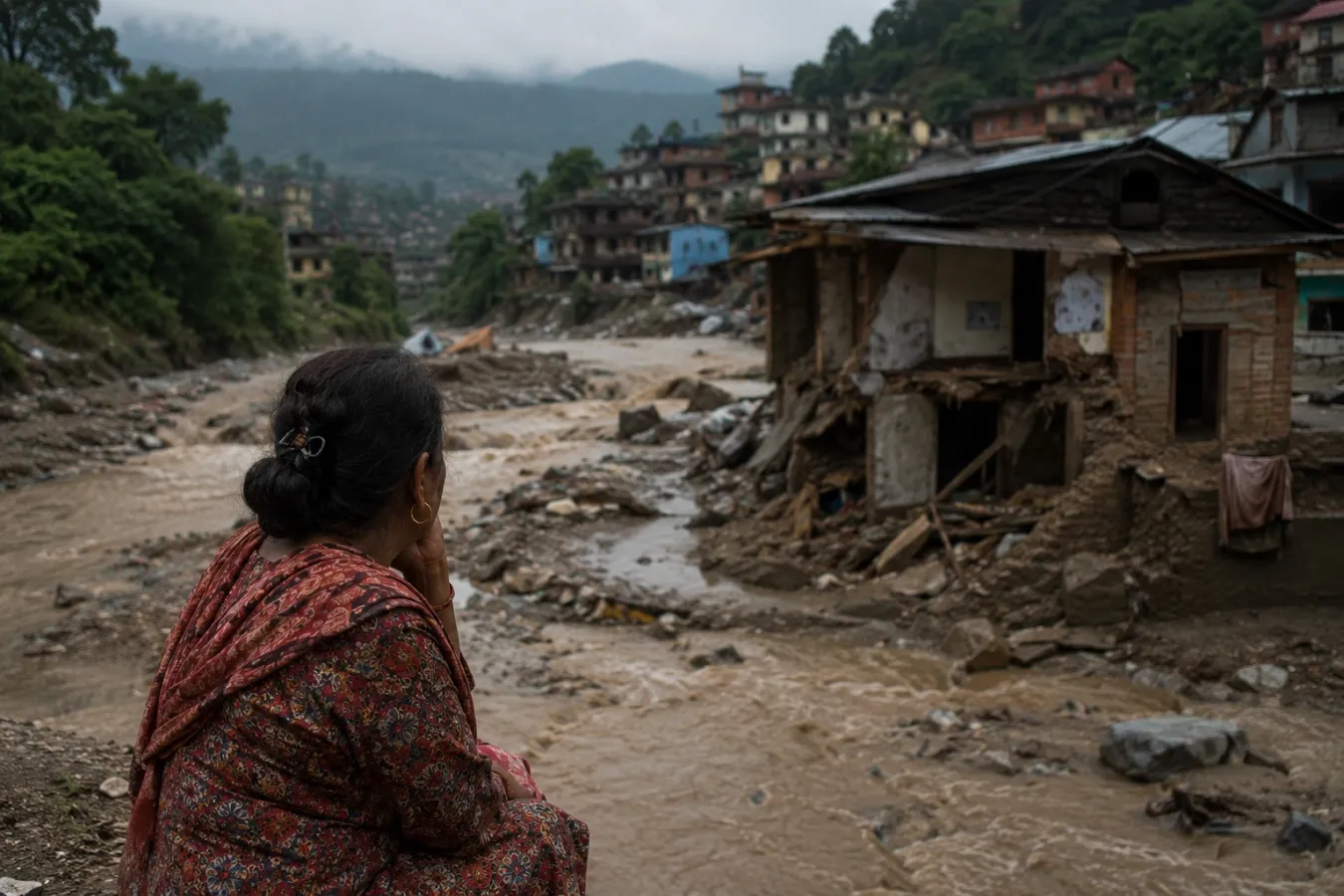
On the morning of August 26, 2026, a wall of water and debris tore down the Bhote Koshi and Trishuli rivers after a glacier collapse near the Nepal-Tibet border triggered a catastrophic flash flood. Within hours, the Gyirong checkpoint was destroyed, dozens of settlements across a 72-kilometre stretch were buried, and villages like Timure and Syaphrubesi effectively disappeared. As of the latest figures, more than 900 people are confirmed dead in Nepal alone, with over 4,000 still missing among them foreign trekkers, hydropower workers, security personnel, and children.
The U.S. Geological Survey estimates more than 100 million cubic metres of ice, rock, and debris were displaced in the initial collapse. Fourteen hydropower and solar projects, with a combined capacity of roughly 748 megawatts, were damaged or destroyed. Dozens of schools have been flattened, leaving an estimated 10,000 children without a classroom to return to.
This is not an isolated tragedy. It is the latest entry in a pattern that has repeated with brutal regularity: 2021, 2024, and now 2026. In 2024 alone, monsoon flooding killed more than 300 people, damaged 25 bridges and 11 hydropower stations, and caused an estimated Rs17 billion in losses. Nepal is not simply unlucky. It is structurally exposed and the numbers explain why.
A country that didn't light the fuse
Nepal contributes roughly 0.025–0.027% of global greenhouse gas emissions. Its per-capita carbon footprint, at under two tonnes of CO2-equivalent a year, is a fraction of the emissions generated by industrialized economies. Yet the Climate Risk Index ranks Nepal among the ten most climate-vulnerable countries on Earth. This is the defining injustice of the climate era: the nations that did the least to cause the crisis are absorbing the sharpest edge of it.
The reason lies in geography as much as politics. Nepal sits within the Hindu Kush Himalaya, a region warming at roughly twice the global average and home to more glacial ice than anywhere outside the polar regions. Nepal's glaciers have already lost close to a quarter of their area since the late 1970s, and researchers have identified dozens of glacial lakes across the Koshi, Gandaki, and Karnali river basins that are considered dangerous enough to trigger sudden, catastrophic outburst floods — the very phenomenon suspected in the August 2026 disaster.
The Asian Development Bank projects that unchecked climate change could shave 2.2% off Nepal's annual GDP by 2050. For a country still developing basic infrastructure, that is not an abstract projection; it is a subtraction from the resources needed to build the roads, bridges, and warning systems that might have saved lives this month.
Globalization's uneven bargain
Nepal's predicament is a case study in how globalization distributes risk unevenly. Global supply chains, industrial expansion, and consumption patterns concentrated in wealthier economies have driven the emissions now destabilizing the Himalayan cryosphere. Nepal, meanwhile, has been drawn into globalization mainly as a source of labor migration, hydropower export, and adventure tourism sectors that are themselves now being battered by the very floods that global emissions helped produce.
The hydropower plants swept away this week were not just infrastructure; they represented a development strategy built on exporting clean energy to earn foreign revenue, now undercut by the instability that a warming climate has introduced into the rivers that fuel them.
Domestic factors compound the exposure. Post-2015-earthquake reconstruction, rapid and often unplanned urbanization along floodplains, and settlement patterns that place homes, schools, and trekking routes close to rivers have all been flagged by Nepal's own Ministry of Home Affairs, which estimates that roughly 80% of the population faces some form of climate-related hazard risk. Poor drainage infrastructure and weak land-use enforcement turn a heavy monsoon rain into a national emergency almost every year.
What accountability should look like
Nepal has not been passive. It has committed to a net-zero target by 2045, pledged to expand forest cover to 45% of its land area, and built early-warning systems at its highest-risk glacial lakes through its National Adaptation Plan. Community forestry programmes managing close to two million hectares are held up internationally as a model.
But adaptation measures funded by a Rs5 billion national disaster relief pot cannot substitute for the loss-and-damage financing that climate-vulnerable nations have spent a decade demanding at UN climate conferences financing that remains chronically underfunded relative to need.
The flood in Rasuwa, Nuwakot, and Dhading is a warning written in the starkest terms: melting glaciers, swollen rivers, and buried villages. The question this disaster poses is not only what Nepal must do to protect itself, but what the rest of the world the emitters whose carbon has reached even the remotest Himalayan valleys owes in return.
Sources: CARE International; CNN; UNICEF USA; World Bank (Climate risks, exposure, vulnerability and resilience in Nepal); Asian Development Bank; Nepal Ministry of Population and Environment (First NDC submission to UNFCCC); Frontiers in Climate (2026); Wikipedia entries on the 2021, 2024, and 2026 Nepal floods.